
About Pilates
Pilates is a form of exercise that focuses on developing strength, mobility, balance and body awareness through controlled, purposeful movement. Rather than simply repeating exercises, Pilates encourages you to pay attention to how you move, helping the body work efficiently and as a coordinated whole.
Originally developed by Joseph Pilates in the early 20th century, the method has continued to evolve while retaining its emphasis on mindful movement and the connection between body and mind. Pilates can be adapted for different ages, abilities and levels of experience, from those beginning exercise to experienced practitioners and athletes.
Joseph Pilates
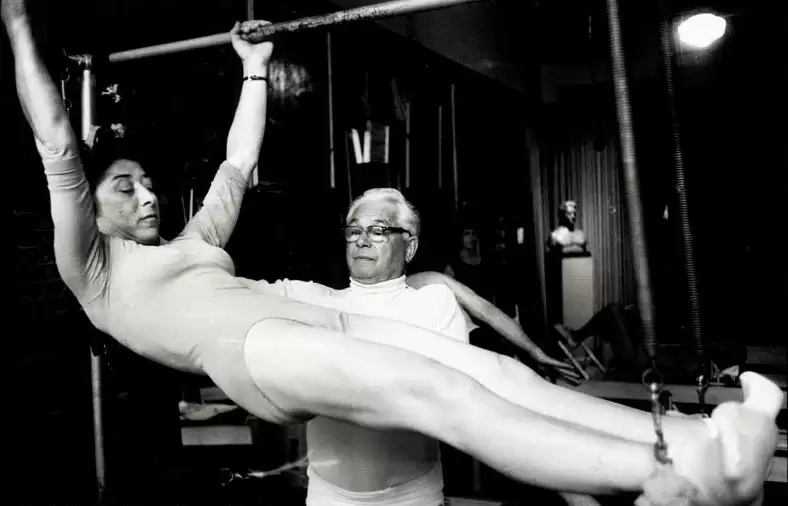 Joseph Pilates described his equipment as a way of providing carefully controlled resistance, encouraging the deeper muscles of the body to work while allowing the individual to focus on the quality of each movement. Central to his approach was the belief that exercises should be performed slowly, smoothly and with the whole body engaged. Joseph Pilates was born near Düsseldorf, Germany, in 1883. Although relatively little is documented about his childhood, he is widely reported to have suffered from poor health, including asthma, rickets and rheumatic fever. Determined to improve his physical strength and fitness, he devoted himself to exercise and went on to become an accomplished gymnast, diver and skier. In 1912, Pilates moved to England, where he worked as a circus performer, boxer and self-defence instructor. When the First World War began, he was interned in Britain alongside other German nationals. During his internment, he continued developing his ideas about physical conditioning and began teaching exercise to his fellow internees.
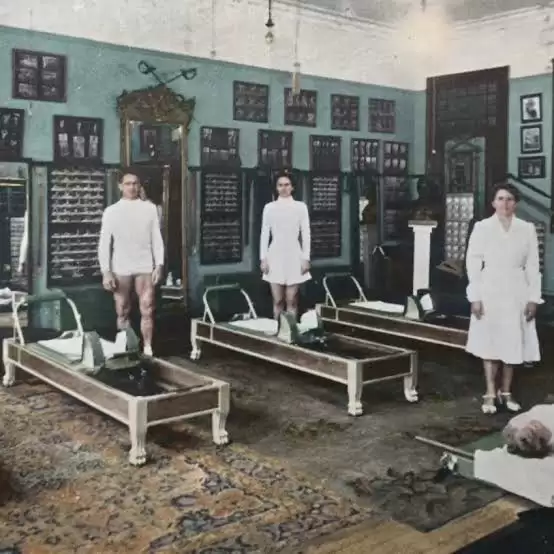 Later in the war, while working as an orderly at a hospital on the Isle of Man, Pilates worked with patients who had limited mobility or were unable to walk. He experimented with attaching springs to hospital beds to provide support and resistance for their limbs. These early ideas helped inspire the specialist apparatus that would later become closely associated with his method, including the Cadillac. Modern versions of much of this equipment can still be found in Pilates studios today. In the 1920s, Joseph emigrated to the United States with his wife, Clara. Together they opened a body-conditioning studio in New York in 1926, where they developed and taught his approach to movement and exercise. The studio contained a range of apparatus designed to support conditioning and rehabilitation. Their work became particularly popular within New York's dance community, where Pilates was used both to develop physical technique and to help dancers recover from injuries. Despite its later association predominantly with women, a significant proportion of the studio's early clients were men. Joseph Pilates published Your Health in 1932, setting out many of his ideas about physical wellbeing. This was followed in 1945 by Return to Life Through Contrology, which described his exercise philosophy and included a series of mat exercises.
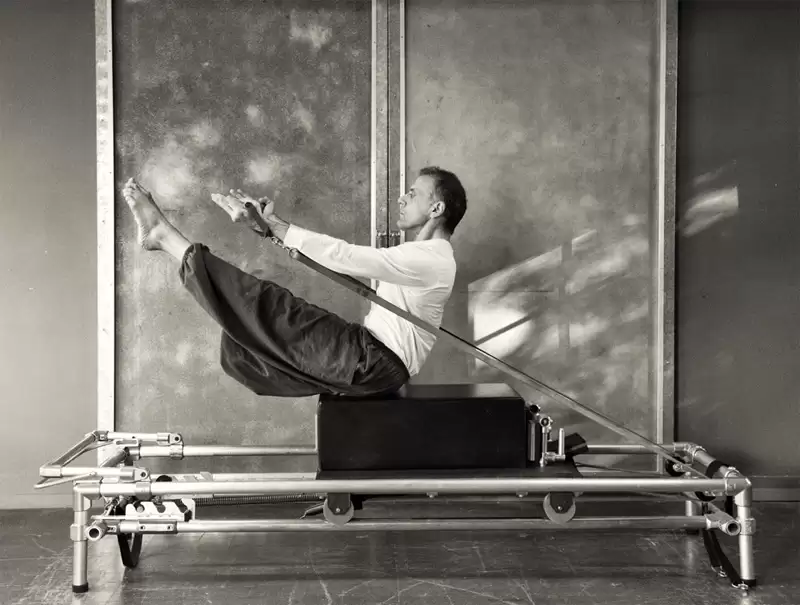 During his lifetime, Joseph called his system Contrology, reflecting his emphasis on consciously controlling the body through movement. Following his death in 1967, at the age of 83, the approach gradually became more widely known as the Pilates Method. Although Joseph developed the method and its apparatus, Clara Pilates played an equally important role in its development and continuation. She became an influential teacher within their New York studio and helped pass the work on to the next generation of practitioners. Those who studied directly with Joseph and Clara — often referred to today as the Pilates Elders — remembered Clara as a particularly nurturing and intuitive teacher. Her willingness to adapt exercises to the abilities and individual needs of each person helped establish an important principle that continues within Pilates teaching today: the method should serve the individual, rather than requiring every individual to practise in exactly the same way.